11.17.2012

Mango-Raspberry Breakfast Cake

Mango-raspberry breakfast cake

The National Mango Board recently contacted me and asked if I'd like to receive a box of mangos along with some classic holiday spices to inspire me to make some sort of holiday mango dish. I was excited because I love mangos, but I wasn't so sure how I felt about combining them with holiday spices. But the Mango Board was right, and those spices, which filled the whole kitchen with their varied fragrances when I unpacked them, inspired me to start baking.

I know the holidays are usually centered on a big dinnertime meal, but breakfast is just as important during the holidays as it is every other day. So I decided to make a breakfast cake that would get everyone's day off to the right start. And this breakfast cake, filled with cinnamon and ginger and chunks of mango and whole raspberries, with a gingery streusel topping, might do just that.


Mango-Raspberry Breakfast Cake (adapted from Joy the Baker)
Print this recipe

Ingredients

Cake
3 eggs
3/4 cup canola oil
2 1/2 cups flour
1 cup sugar
1 1/2 teaspoons ginger
1 teaspoon cinnamon
1 teaspoon baking powder
1 teaspoon baking soda
1/4 teaspoon kosher salt
1/2 cup light brown sugar
1 mango, peeled and diced
1/2 cup frozen raspberries

Streusel
1/4 cup flour
1 tablespoon ginger sugar* (or 1 tablespoon sugar plus 1/8 teaspoon ground ginger)
1 tablespoon brown sugar
3 tablespoons cold unsalted butter, cut in small cubes

Preparation

Cake
Preheat oven to 350 degrees. Grease and flour 10- by 7-inch glass baking dish.

Whisk eggs and oil together (I mixed them in a 2-cup liquid measuring cup). In a large bowl, whisk flour, sugar, ginger, cinnamon, baking powder, baking soda, and salt together. Break up brown sugar (make sure there are no clumps) and whisk it into dry ingredients. Stir in egg-oil mixture with rubber spatula.


Stir in mango and raspberries.


Spread batter in prepared dish.


Streusel
Mix flour, ginger sugar, and brown sugar together in small bowl. Rub in butter with fingers until it's evenly distributed. Sprinkle streusel over batter.

Bake cake for 45 to 55 minutes, turning halfway through baking, until top is golden brown and toothpick comes out with just a few moist crumbs attached.

Transfer to wire rack and let cake cool completely in pan.

Mango-raspberry breakfast cake

Cut and serve.

Mango-raspberry breakfast cake

*One of my friends makes this awesome ginger sugar with flecks of ginger in it, and she gave me some to experiment with. I loved the flavor it added to the streusel topping.

What would you make with mangos and spices (cinnamon, ginger, cumin, cayenne, etc.) for the holidays?

11.16.2012

Maple Buttered Roasted Squash And Brussels Sprouts


Vermont Butter and Cheese Creamery has a new cultured butter -- and it's blended with sea salt and maple. As soon as I heard about it, I knew I wanted to try it. And VBCC generously offered me a sample. When the butter arrived, I was craving fall veggies and figured I could use it to dress them up.

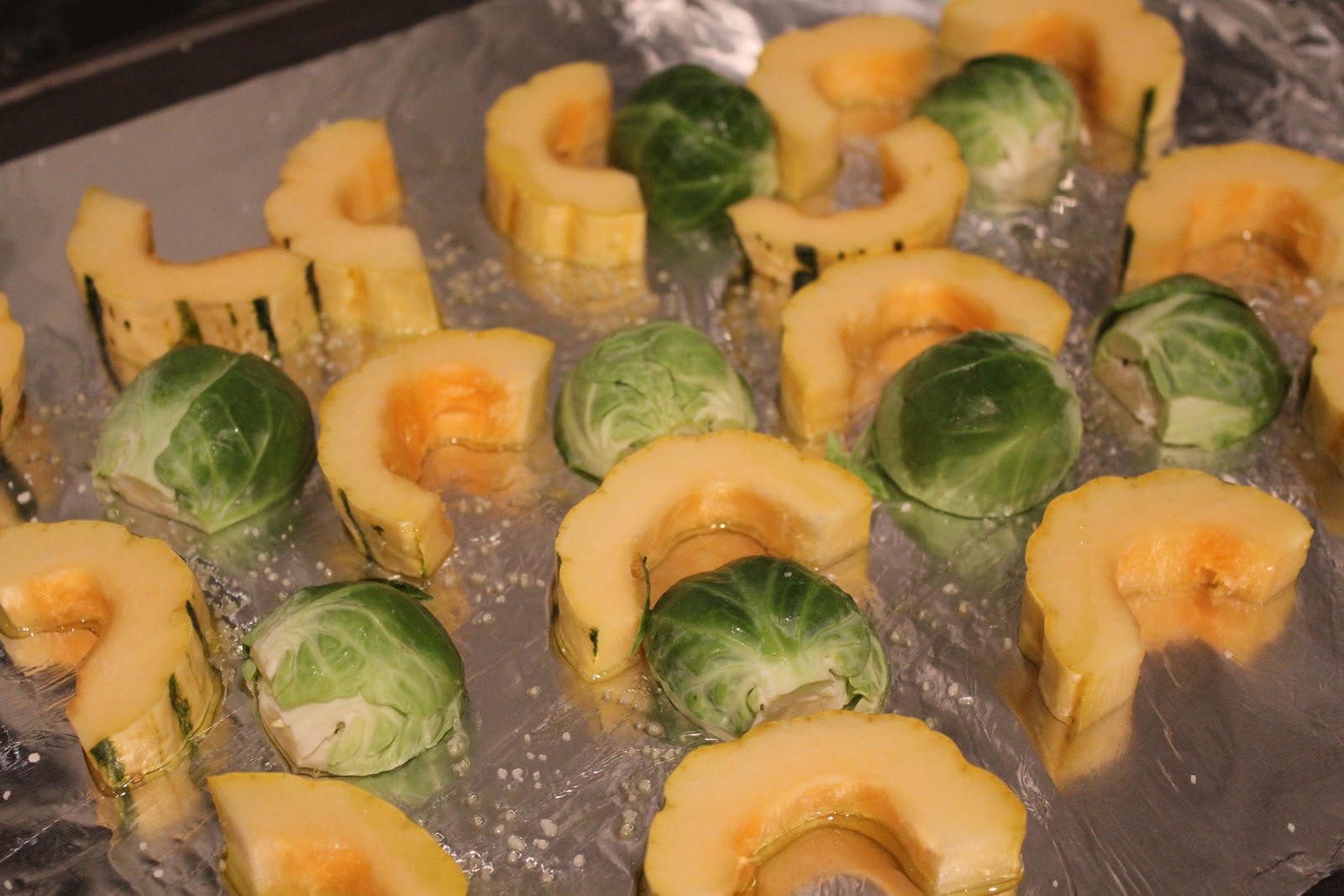
I picked up a small delicata squash and a handful of brussels sprouts and got to work.

Maple buttered roasted squash and brussels sprouts

Maple Buttered Roasted Squash And Brussels Sprouts

Ingredients

Olive oil
1 small delicata squash, halved, seeds scooped out, and sliced 1/2 inch think
4 large brussels sprouts, trimmed and halved
Kosher salt and pepper
1 tablespoon Vermont Butter and Cheese Creamery Cultured Butter Blended with Sea Salt & Maple

Preparation

Preheat oven to 425 degrees. Line a baking sheet with foil and drizzle some oil over the foil.

Arrange the squash slices and brussels sprouts (cut side down) on baking sheet. Season with salt and pepper and drizzle with more oil.

Bake for about 30 minutes, turning vegetables over halfway through, until brussels sprouts are golden brown and squash is tender and browned.


Top veggies with butter.


Maple buttered roasted squash and brussels sprouts

And enjoy!

I love simple roasted veggie dishes like this during the fall, and having the maple and sea salt flavors from the butter kicked this up a notch, not to mention that the butter itself was so rich and creamy.

Note: The butter was complimentary but all opinions are my own.

What would you do with maple and sea salt butter?

11.14.2012

Honeymoon -- Day 5 -- Modena (Part 1)

Our original plan for October 13 was to get up early and get on the road to Florence, but there was a food tour in Modena with Italian Days that sounded really fun, and the only day there was availability was the 13th. We decided to bite the bullet and do the tour and just get to Florence in the early evening. This ended up being the best decision because this day ended up being the best day of our trip.

We had to meet the driver in our hotel lobby at 6:50 a.m. (you can bet we were both muttering about how the tour had better be worth getting up so early). We sleepily got in the van and headed to Modena, stopping to pick up another couple on the way. After 15 minutes or so, we all warmed up a little and started chatting. We learned that the other couple was from New York and also on their honeymoon. The rest of the drive flew by and before we knew it, we were standing outside a Parmigiano-Reggiano factory. There we met two other van loads of people and our guide Alessandro.

Alessandro introduced himself and handed us all "cheese jackets" to put on before we headed inside. The reason we had to get up so early was so that we could see the cheese makers at work and learn about how Parmigiano-Reggiano is made, from start to finish.


First, the name Parmigiano-Reggiano comes from two regions where the cheese is produced: Parma and Reggio Emilia. (The cheese is also produced in Bologna and Modena -- it must come from one of these places in order to be called Parmigiano-Reggiano.) Parmigiano-Reggiano is made with three ingredients: skim milk (the milk sits overnight and is skimmed in the morning), fresh milk, and calf rennet (an enzyme from the calf's stomach, which helps coagulate the cheese). These ingredients are poured into large copper vats. The vats are cone-shaped and go down into the floor. The contents of each vat produce only two wheels of Parmigiano-Reggiano.


As the mixture is heated, it will begin to form curds.


The curds are broken apart into very small pieces with this special tool.


The mixture is then heated to 55 degrees Celsius, and the curds start to gather and clump into a single mass in the bottom of the vat.


Once the mass has formed, it must be lifted out with the aid of this paddle. The cheese makers then tie it with cheese cloth and cut the mass into two pieces, which will become the two wheels of Parmigiano-Reggiano.


Each ball of cheese is placed in one of these plastic containers along with a strip that will put the markings around it.


Eventually the cheese is moved to these airy metal holders, which allow it to dry and give it its shape. The wheels need to be turned periodically.


After that the wheels are removed form their metal casings and are put in a salt water brine for 18 days. This gives them much of their flavor.


Then they are stored so they can age. They must age for at least one year. During this time, they dry out and get a natural crust, but they also get oily, so this special machine goes up and down the rows of cheese and cleans all of the wheels periodically.


After the cheese has aged, it must be checked for quality. The head cheese maker will tap the cheese, listening for any inconsistencies and imperfections.


Then the Consortium comes in and checks the cheese and determines whether it can receive the DOP seal and be called Parmigiano-Reggiano. Each wheel will be given first grade or second grade status. If a wheel doesn't measure up, it's designated third grade and becomes just "cheese," meaning it cannot be called Parmigiano-Reggiano.

The wheels continue to age for a total of 18 to 24 months before they are ready to leave the factory.


We really learned a lot on the factory tour, and I did my best to share it all with you here, but I didn't take notes during the tour so I'm hoping I remembered everything correctly! You can find more info here.

After the tour we headed outside to sample the Parmigiano-Reggiano. We had a younger cheese and an older cheese. The older stuff is what we get in the United States and is very firm and has crystals. It was interesting to try the younger cheese, which has a creamier texture.


We also drank Lambrusco (a bubbly, food-friendly red the region is known for) and nibbled on some traditional rolls baked with veggies inside and with a lightly salted crust. By the end of the tour, I had definitely fallen in love with Lambrusco. I was already in love with Parmigiano-Reggiano.


And to show my love, we bought two 2.2-pound blocks to bring home. I worried the whole time about bringing cheese back on the plane (even though Alessandro assured us it's okay to bring Parmigiano-Reggiano back to the US), but we claimed it at customs, and no one even batted an eye.


The rest of the tour is coming up next in my honeymoon series...

11.12.2012

Honeymoon -- Day 4 -- Bologna (Afternoon/Evening)

After lunch, we walked through the market at Quadrilatero. There are tons of shops lining the streets that sell meats, cheeses, produce, and specialty products. It's fun to just wander around and look at everything that's available.


As the market (and everything else around) started to close down for the afternoon, we walked back toward the hotel so I could take my afternoon nap.

Early evening rolled around and we ventured out again. This time we visited the Basilica Santuario di San Domenica, which was just around the corner from our hotel. It was stunning inside.


After that, we went in search of pizza. We decided it would be fun to try the pizza in each city we stayed in. It was tough to find pizza by the slice in Bologna, and what we did find was thick crust pizza cut in squares. I went for a piece of sausage pizza (I was almost swayed by the prosciutto pizza but that one doesn't have sauce), and Jeff had Margherita. The pizza was fine for a quick snack; it just wasn't anything memorable.


We kept wandering around and exploring Bologna, and we eventually walked by a chocolate shop (Majani) that I had been wanting to go in -- that we had walked by three times before and found closed -- and it was actually open this time. We got some different chocolates to sample, and they were so good I wish we'd gotten more. The chocolates are just so smooth and creamy.


It was getting late enough to start thinking about dinner, and a place called La Traviata had been recommended to us by a friend of a friend who lived in Bologna. She said they had millions of fresh pastas and that was enough to pique my interest. We walked over to see if we could get a table. Because we didn't have a reservation, we were offered an outside table, which was just perfect.


The restaurant is owned by a husband and wife, Antonio and Manuela. Manuela came out to tell us about the pastas, all of them made by her by hand, while Antonio playfully butted in with the wine list. We selected our wines and then listened to Manuela's descriptions of the pastas that were available that night. There were so many that I wanted, but I finally decided to go with pumpkin tortellini. She mentioned something about how she usually cooks it with balsamic, and I said that sounded perfect.

We sipped our wines and chatted while we waited for our pastas to come out. I had a glass of Valpolicella, and Jeff had to get a half bottle of white because they don't do whites (or maybe it was just the white he wanted) by the glass. No big deal; I helped him finish it.


Jeff had cheese-filled tortellini with Bolognese sauce (he's a creature of habit). I think this was his favorite version of the meaty dish.


My pumpkin tortellini featured two kinds of fresh pasta, a light cream sauce, prosciutto, a generous drizzle of balsamic, and walnuts. It was incredible. The salty and sweet components played off of each other.


Manuela also makes all the desserts, so of course we had to try some. Jeff ordered chocolate cake (it was so moist) with mascarpone and chocolate sauce.


I got panna cotta with chocolate sauce (one of my favorite desserts). This one was delicious and had the right texture, firm and not at all flan-like. It was cut in thin slabs and nicely doused with the chocolate sauce.


This was definitely one of my favorite dinners of the whole trip, and I highly recommend La Traviata to anyone visiting Bologna.

Next up: Day 5 -- Modena (Part 1)